
IR vs TSER: The Ceramic Tint Number Installers Get Wrong
Sunday, November 22, 2026
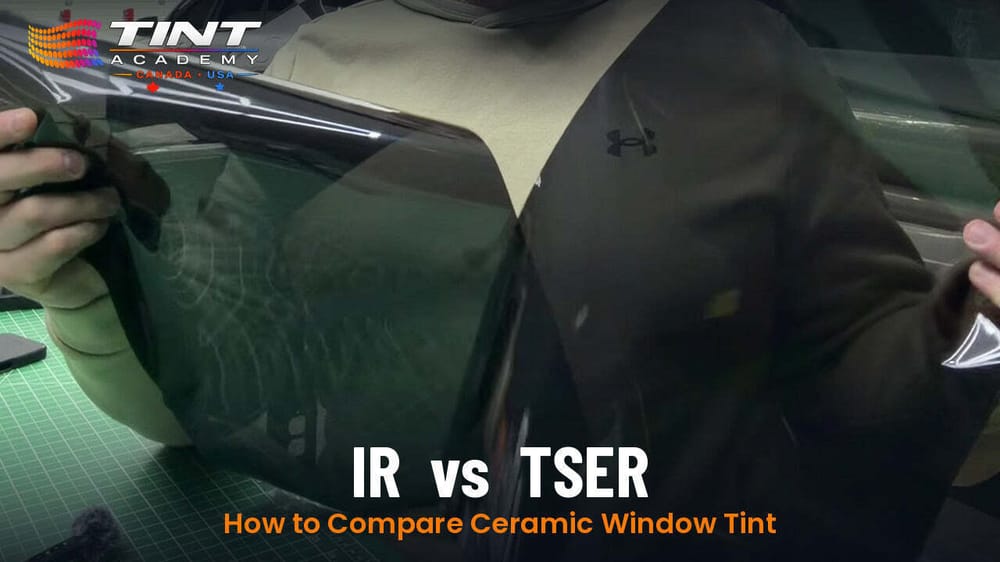
Two premium ceramic window films. One is advertised with a big infrared rejection number. The other is advertised by its total solar energy rejection. Which one actually keeps the car cooler?
In this 4-minute video, Adam from Tint Academy explains why those two numbers are not measuring the same thing — and how to compare ceramic window films without getting sold on a single IR percentage. You might think the 95% sounds better, but IR rejection and TSER are not the same measurement.
Watch: IR vs TSER — The Ceramic Tint Number Installers Get Wrong
Watch the full video on YouTube.
What Infrared (IR) Rejection Actually Measures
First, infrared, or IR. Sunlight is made up of different types of energy: ultraviolet, visible light, and infrared. Infrared makes up a significant portion of the sun's energy, and it's one of the reasons a vehicle gets hot.
Some ceramic films advertise 90%, 95%, or even 99% infrared rejection, and that sounds incredible to the customer. Here's what that number might not tell you.
Some manufacturers advertise infrared rejection measured at just one wavelength, like 940 nanometers. Others measure across a much wider infrared spectrum. Those are two very different measurements. A film can perform extremely well at one specific wavelength but reject considerably less energy across the entire infrared spectrum.
What Is TSER? Total Solar Energy Rejection
TSER — total solar energy rejection — looks at the total amount of solar energy the film and the glass system prevent from entering the vehicle: ultraviolet, visible light, and infrared combined.
Unlike a narrow infrared measurement, TSER accounts for energy that is reflected, transmitted, and absorbed, including how absorbed heat transfers through the glass. That gives you a more complete picture than a single IR percentage.
Example: 95% IR / 45% TSER vs 80% IR / 60% TSER
Adam uses a clear example. One film has 95% infrared rejection but only 45% TSER. Another film has 80% infrared rejection and 60% TSER. Assuming both are tested under comparable conditions, the second film rejects more solar energy.
That's why a higher infrared rejection number does not automatically mean better overall heat rejection.
Why Companies Market IR — and Why 99% IR on the Box Isn't Enough
So why do some companies market IR and nothing else? A number like 95 or 99 looks fantastic on a brochure or on the wall in the shop. And to be fair, infrared rejection is a real measurement. It can tell you something useful about the film you're installing. But without knowing the wavelength range and the testing method, that number doesn't tell the full story.
Adam's advice is direct:
- Don't just buy film because the box says 99% IR.
- Don't get it installed just because an installer says it has 99% IR.
- Don't assume the most expensive ceramic film automatically has the best performance.
- Ask for specifications.
Compare Similar Shades, Glass, and Testing Standards
Here's one more thing that can throw off a comparison. You might be looking at a 5% ceramic film against a 35% ceramic film. The darker film may show a higher TSER simply because it blocks more visible light.
When you compare two ceramic films, make sure you're comparing similar shades, the same glass conditions, and the same testing standards. Otherwise, you're not making a fair comparison — whether the film is going on a car or a house.
Three Things to Compare: TSER, VLT, and IR
Here's what Adam recommends to every installer and every customer comparing ceramic films:
- TSER — How much total solar energy does the film and glass system reject?
- VLT — Visible light transmission: how dark is the film? Make sure you're comparing similar shades.
- Infrared rejection — Ask the manufacturer what wavelengths were tested, and whether the number represents one wavelength or a broader range.
Understand the Product, Not Just the Install
At Tint Academy, we teach that understanding the product is just as important as knowing how to install it. When a customer asks why one ceramic film costs more than another, you should be able to explain the difference — not just repeat a marketing claim.
IR tells you part of the story. TSER gives you a more complete picture of how the film is actually working.
Learn Window Tint at Tint Academy
If you want to learn window film — how it works, and how to build a successful tint business — Tint Academy's hands-on window tint courses cover product knowledge as well as install skill.
Watch next:
Watch next: Stop Practicing on Cheap Window Film — And the Scorpion Bargain Bin, and How to Use a Plotter with Scorpion SCAN: 2026 Hyundai Kona Tint Install.
For hands-on window tint training, visit tint.academy.
Call or text USA 321-364-9518 or Canada 289-201-2070.
IR vs TSER FAQ
Infrared (IR) rejection is often measured at just one wavelength, like 940 nanometers, or across a wider infrared spectrum — two very different measurements. TSER, or total solar energy rejection, looks at the total amount of solar energy the film and the glass system prevent from entering the vehicle: ultraviolet, visible light, and infrared combined. IR tells you part of the story. TSER gives you a more complete picture of how the film is actually working.
Yes. In Adam's example, one film has 95% infrared rejection but only 45% TSER, and another has 80% infrared rejection and 60% TSER. Assuming both are tested under comparable conditions, the second film rejects more solar energy. A higher IR number does not automatically mean better overall heat rejection.
A number like 95 or 99 looks fantastic on a brochure or on the wall in the shop. Infrared rejection is a real measurement, and it can tell you something useful about the film. But without knowing the wavelength range and the testing method, that number doesn't tell the full story. Don't just buy film because the box says 99% IR.
VLT is visible light transmission — how dark the film is. You might be comparing a 5% ceramic film against a 35% ceramic film. The darker film may show a higher TSER simply because it blocks more visible light. Compare similar shades, the same glass conditions, and the same testing standards.
Adam recommends three things: TSER (how much total solar energy the film and glass system reject), VLT (how dark the film is, so you can compare similar shades), and infrared rejection (and ask the manufacturer what wavelengths were tested, and whether the number is one wavelength or a broader range). Ask for specifications, and don't assume the most expensive ceramic film automatically has the best performance.
Adam teaches that understanding the product is just as important as knowing how to install it. When a customer asks why one ceramic film costs more than another, you should be able to explain the difference — not just repeat a marketing claim. For hands-on training, visit tint.academy, or call or text USA 321-364-9518 or Canada 289-201-2070.

Hi, I Am Jane Doe
CEO Of Best Blog Ever
Lorem ipsum dolor sit amet, consectetur adipisicing elit. Autem dolore, alias,numquam enim ab voluptate id quam harum ducimus cupiditate similique quisquam et deserunt,recusandae.
Get Our Best Selling Product!
You just read about this...
Super excited about this product? We are, too! We just wrote this whole blog post that mentions it.
Ready to buy it? Get access to the Product here:

PAGES
SOCIAL
