
- Window tint certification usually comes from a training provider or a film manufacturer. It shows you completed training, not that a government licensed you.
- Rules on how dark tint can be are set locally by each province or state. Business licensing and insurance rules also vary by area.
- A useful certification is built on hands-on work on real vehicles, not just an online quiz.
"Do I need to be certified to tint windows?" is one of the first questions new installers ask us. The honest answer is that it depends on what you mean by certified, and on where you work. Here is how certification, licensing and local tint rules fit together in Canada and the USA.
Certification vs. licence: what is the difference?
A certification is issued by a training school or a manufacturer. It shows you completed a course and met that organisation's standard. A licence is issued by a government and is a legal requirement to do certain work.
In most of Canada and the USA there is no separate government trade licence just for automotive window tinting. That does not mean there are no rules. Depending on where you are, you may need a general business licence, insurance, sales tax registration, or to follow local rules about tint darkness, compliance stickers and paperwork for customers. Always check the requirements in your own province, state, county or city before you start charging for work.
Why certification still matters
Even when it is not legally required, certification helps in practical ways:
- Customer trust. Car owners are handing you a vehicle worth thousands. A certificate shows you trained properly.
- Dealership and fleet work. Dealers and businesses often want to see proof of training before they send you work.
- Film supplier relationships. Some film brands offer programs, pricing or warranties to trained installers.
- Your own confidence. A structured course gives you a repeatable method for every window, which makes your quality more consistent.
What a good window tint certification should prove
Not every certificate is equal. Before you pay, check that the training behind it covers:
- Glass preparation and contamination control, the cause of most failed installs.
- Every type of window: roll-down side windows, quarter glass, frameless doors and rear windshields.
- Heat shrinking film to curved rear glass.
- Tint removal, because many jobs start with stripping old film.
- Hands-on time on real vehicles, with an instructor correcting you.
- The business side: pricing, quoting and handling customers.
For more ways to compare schools, use our 12 questions to ask before you book a window tint course.
How to get certified with Tint Academy
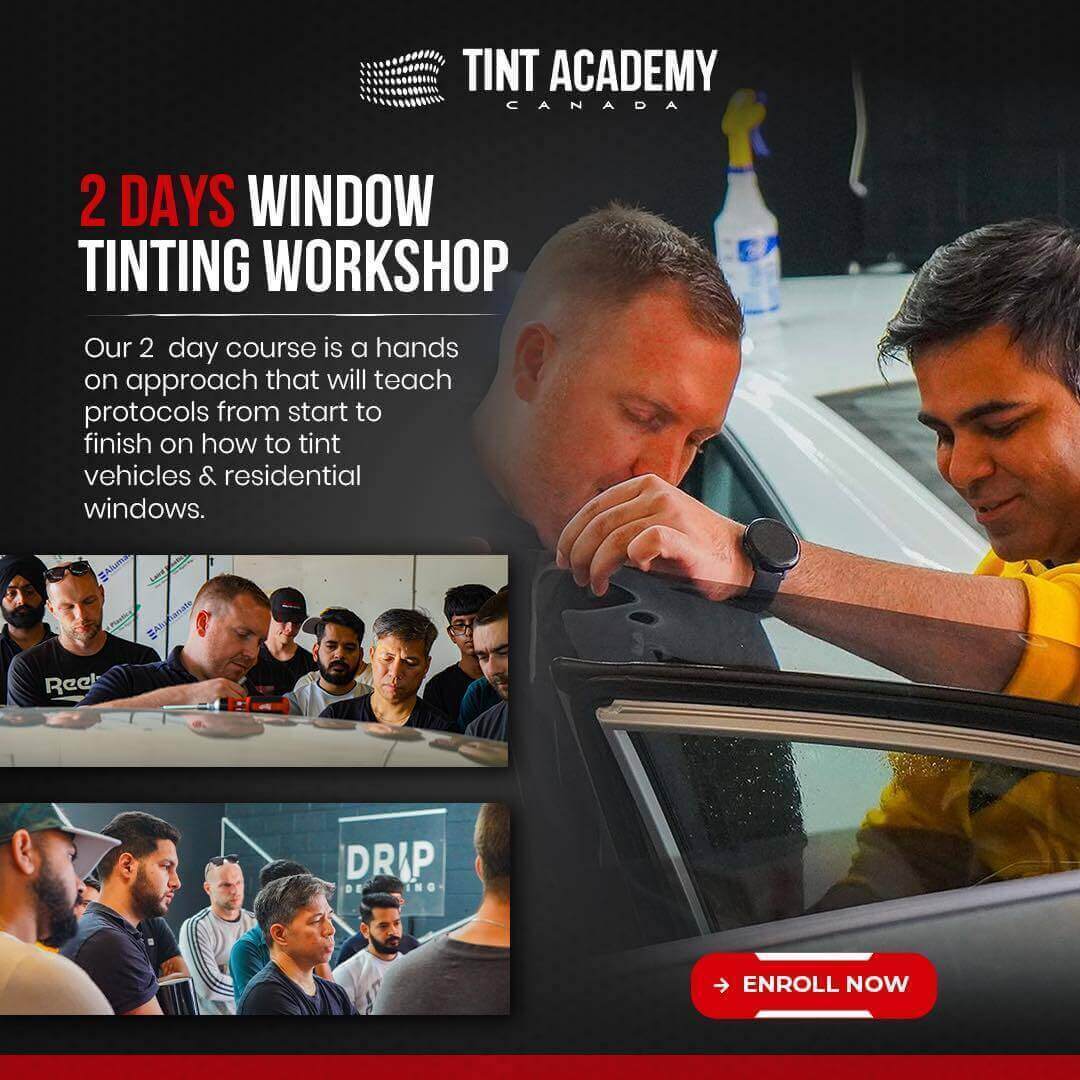
Tint Academy has trained more than 6,500 students over 10 years. Our in-person window tint course is 2 full days on real vehicles, and students who complete it receive Tint Academy certification. You also keep:
- A professional window tint tool kit
- A 100 ft roll of ceramic automotive window film
- Access to the online window tint training course
- Lifetime mentor support, a student community and supplier access
Classes run in cities across Canada and the USA. Venues include Jax Wax Factory Warehouse for Toronto, Nano Quartz in Niagara Falls, RAD Detail in Halifax, Buff N Bling in Edmonton, Owner's Pride in Orlando, Solar Spectrum in Keller for Dallas, The Bays in Mesa for Phoenix, Detail City in Las Vegas and Scorpion Films HQ in Cloverdale, Indiana. See the course locations page for current dates.
If you cannot travel, the online window tint certification course covers the theory and techniques you can then practise at home.
Certification in Canada
Tint darkness rules in Canada are set provincially, so what is legal in Ontario can differ from Alberta or Nova Scotia. Customers will ask you what is allowed, so learn your province's rules and keep up with changes. For city-specific training, see our guides to window tint training in Toronto and Niagara Falls and training in Halifax and Edmonton.
Certification in the USA
In the USA, tint laws are set by each state, and some states have extra requirements such as compliance labels or medical exemption paperwork. If you work across state lines, learn the rules for each state you serve. Our guide to training in Dallas, Phoenix and Las Vegas covers three hot-climate markets where tint is in high demand.
After you are certified
A certificate is the start, not the finish. Keep practising, keep photos of your strongest work, ask customers for reviews and keep learning new skills. Many tinters later add PPF training to offer paint protection to the same customers.
Training certificates vs. manufacturer programs
You may see two kinds of credentials in the tint industry. A training certificate shows you completed a course with a school like Tint Academy. A manufacturer program is run by a film brand and may offer dealer pricing, marketing support or warranty registration for installers who meet that brand's standards. The two can work together: many installers train with a school first, then join a film brand's program as their business grows. Ask any manufacturer directly what their program requires.
What customers actually look for
Most car owners never ask to see a certificate. What they look for is evidence that you know what you are doing:
- Photos of clean, finished installs on vehicles like theirs
- Reviews from real customers
- Clear answers about film types, legal limits and warranty
- A professional quote and a tidy, organised workspace
Certification supports all of this, but it does not replace it. Treat your certificate as the foundation and build your reputation on top of it.
Questions to ask before paying for certification
- How many hours will I spend installing film myself?
- Will I work on real vehicles, including rear windshields?
- What exactly does the certificate say, and what do I need to complete to receive it?
- What support is available after the course?
- Do I keep tools and film?
Our full checklist of questions to ask before booking goes into each of these in more detail.
Get certified hands-on
Choose your city and date for the 2-day window tint certification course.
Frequently asked questions
Do you need a licence to tint car windows?
In most of Canada and the USA there is no government licence just for automotive window tinting, but you may need a business licence, insurance or to follow local tint rules. Check your province, state and city.
Is window tint certification worth it?
For most new installers, yes. It shows customers and dealers you trained properly, and the training behind it gives you a repeatable method for every window.
How long does it take to get window tint certified?
The Tint Academy in-person course is 2 full days, 9:00 AM to 5:00 PM each day, on real vehicles.
Can I get window tint certified online?
Yes. Tint Academy offers an online window tint certification course. Hands-on practice is still important to build speed and quality.